
Duration
Funding
Initiative
Budget
Team members
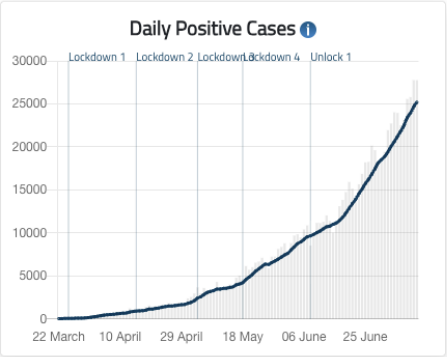
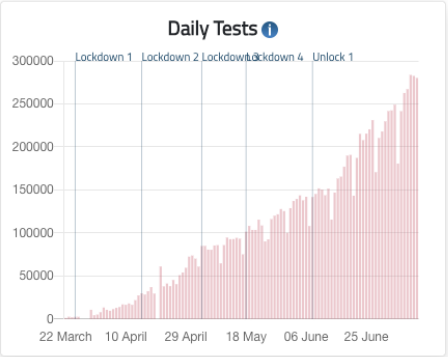
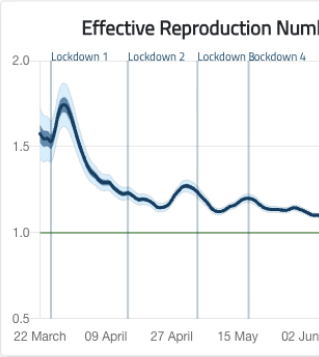
COVID Today was developed as a real-time, science-driven public health data platform under the UDAAN initiative by the India COVID Apex Research Team (iCART). The platform combined automated data pipelines, advanced analytics, epidemiological modeling, and interactive visualization to provide a continuously updated national and sub-national picture of the pandemic. It served multiple audiences simultaneously — policymakers, researchers, media organizations, and the general public — enabling evidence-based decision-making and improving situational awareness at a critical time.
The early phases of the pandemic were marked by rapidly changing case definitions, variations in state-level reporting practices, delays in data release, and the absence of standardised analytical outputs. Health system planners lacked reliable short-term forecasts for hospital bed capacity, oxygen demand, and critical care needs, while researchers and journalists struggled to access harmonised datasets for independent analysis. In addition, public access to credible, comprehensible information was limited, creating space for misinformation and misinterpretation. Addressing these gaps required not only a dashboard, but a robust, automated, and scientifically grounded data infrastructure.
The project was designed as an end-to-end data and analytics pipeline that could ingest information from multiple verified sources, clean and standardize it in real time, and generate meaningful outputs for different use cases. Epidemiological models were integrated to produce short- and medium-term projections, while geospatial and demographic layers allowed for granular analysis at state and district levels. Equal emphasis was placed on open access and clarity of communication so that complex analyses could be understood and used by non-specialist audiences. By combining research, technology, and public health practice, the platform moved beyond passive reporting to become an active decision-support tool.
COVID Today was built on a scalable cloud-based infrastructure that enabled continuous data ingestion, automated validation, and high-frequency updates. The system architecture supported large datasets and simultaneous public access while maintaining performance and reliability. The analytical framework incorporated statistical modeling, machine learning approaches, and scenario-based projections to estimate epidemic trajectories and health system requirements. The platform also provided specialized modules for resource planning, trend interpretation, and comparative regional analysis, ensuring relevance for both operational and research purposes.
The initiative was led by iCART as a multidisciplinary volunteer collective bringing together clinicians, epidemiologists, engineers, data scientists, designers, and public health researchers from leading national and international institutions. Scientific mentorship was provided by a panel of senior public health experts, while collaborations with major data and research initiatives strengthened methodological rigour and interoperability. This collaborative structure enabled rapid development, continuous refinement, and the ability to respond to emerging policy and research needs throughout successive waves of the pandemic.
The project illustrated how automated data pipelines, real-time analytics, and epidemiological modelling can be integrated into a unified digital public health infrastructure. It shifted the role of public dashboards from static information displays to dynamic tools for planning and response. The platform also established a replicable model for rapid development of pandemic intelligence systems in resource-constrained settings, highlighting the importance of open data, interdisciplinary collaboration, and scalable technology.
Within the broader collaborative framework, CDPH contributed to the epidemiological design, analytical strategy, knowledge translation, and alignment of the platform with public health decision-making needs. The organisation’s focus on evidence synthesis and operational relevance ensured that the outputs remained policy-useful and scientifically robust.
COVID Today became a widely used reference point for tracking the progression of the pandemic in India, supporting data-driven journalism, academic research, and public understanding. Its projections and analytical outputs contributed to discussions on health system preparedness, resource allocation, and epidemic control strategies. By providing open, standardized, and methodologically transparent data, the platform strengthened trust in evidence-based reporting and reduced barriers to accessing high-quality information. It also demonstrated the feasibility of building large-scale public health intelligence systems through collaborative, volunteer-driven models.
Capital Raised
Clinics Served
Clinics Served
Beyond its immediate use during the pandemic, COVID Today created a foundation for future work in epidemic intelligence, digital surveillance, and data-driven health system planning. The experience demonstrated the critical importance of real-time, transparent, and accessible data ecosystems in managing public health emergencies and informed subsequent initiatives in integrated disease surveillance and decision-support systems.
The lessons from COVID Today continue to shape approaches to public health data integration, automation, and modelling. The platform stands as an example of how multidisciplinary collaboration and open, science-based communication can strengthen preparedness and response in large and diverse health systems.

COVID Today was developed by a multidisciplinary group of clinicians, researchers, data scientists, engineers, and student volunteers working under the India COVID Apex Research Team (iCART). Bringing together expertise from leading institutions and global technology organizations, the team combined epidemiological insight with advanced data analytics and robust technical infrastructure.
Dr Mohak Gupta, MBBS, AIIMS Delhi.
Technology and Data-driven Solutions in Healthcare
Saptarshi Mohanta (Rishi), BS-MS, IISER Pune.
Machine Learning, Deep Learning, Data Applications and Analytics
Aditya Garg, B.Tech CSE, VIT Vellore
Content Creation
Abhinav Gupta, CA Inter, B.Com
Simplifying Complex Structures with Technology
Apurva Thakker, B.Tech CSE, BFCET Bathinda
Solving Problems through Technology
Siddharth Jain, Integrated B.Tech-MBA, IIIT Gwalior.
Data Analysis, Machine Learning